Introduction
Implant dentistry has revolutionized the treatment of edentulous patients, offering solutions that restore both function and aesthetics. One of the key challenges in implantology, however, is ensuring the long-term stability of implants, especially in cases where traditional implant placement methods face limitations. Remote anchorage is an innovative approach to address this challenge, providing enhanced stability and support for dental implants in cases with compromised bone quality or insufficient bone volume.
Remote anchorage refers to the use of an anchoring point that is situated away from the intended site of the implant, often involving the use of adjacent or distant structures to provide additional support. This technique, when properly applied, can significantly improve implant stability, reduce treatment time, and optimize outcomes for patients with challenging clinical conditions.
This article will explore the concept of remote anchorage in implant dentistry, its applications, benefits, and how it can enhance the stability of implants, especially in complex or high-risk cases.
1. What is Remote Anchorage?
In implant dentistry, remote anchorage is a technique that involves the use of an anchoring system located away from the implant site, typically leveraging structures in the jaw or adjacent tissues that can support and stabilize the implant. While traditional implant procedures rely on the immediate surrounding bone and soft tissues for stability, remote anchorage looks beyond the immediate area of the implant, drawing support from further away.
The concept of remote anchorage has evolved primarily in response to the increasing need for implants in patients with insufficient bone volume in the intended implant site. In such cases, relying solely on the surrounding bone might not provide adequate stability, which could compromise the long-term success of the implant. By using structures located remotely, such as the zygomatic bone, the mandible, or even other skeletal structures, remote anchorage can improve the functional integration of implants.
A. Mechanism of Action:
Remote anchorage works by redirecting or distributing the forces of chewing and occlusion from the implant to a more stable or dense bone structure, ensuring that the implant remains functional even when the surrounding bone is insufficient or compromised. This is especially helpful in patients with conditions such as bone resorption, maxillary atrophy, or poor bone quality, where traditional implants might fail due to lack of proper anchorage.
2. Applications of Remote Anchorage in Implant Dentistry
Remote anchorage is primarily used in complex cases where traditional implant placement is not feasible. The following are some of the key scenarios where remote anchorage is beneficial:
A. Severe Maxillary Atrophy
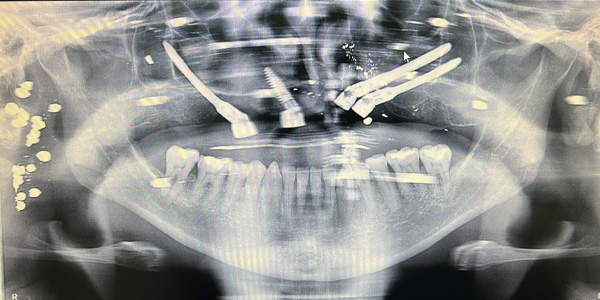
In patients with severe maxillary atrophy, particularly in the posterior region, there is often not enough bone volume or density to support traditional dental implants. This condition can occur due to prolonged edentulism, trauma, or certain systemic conditions that result in bone resorption. In these situations, zygomatic implants serve as a form of remote anchorage.
Zygomatic implants are anchored into the zygomatic bone (cheekbone) instead of the maxillary alveolar ridge. These implants, typically longer and placed at an angle, provide stability in the absence of sufficient maxillary bone, distributing occlusal forces to the more robust zygomatic bone. This form of remote anchorage allows for the placement of implants even in the most challenging cases, enabling patients to regain functional and aesthetic restoration.
B. Insufficient Bone for Conventional Implants
For patients who have lost significant bone volume due to tooth loss or trauma, traditional implant placement may not be an option. Bone grafting can be an expensive and time-consuming procedure, with uncertain outcomes. Remote anchorage offers an alternative, reducing the need for grafting by utilizing existing anatomical structures, such as the zygomatic bone, mandible, or even the pterygoid process.
In cases of lower jaw atrophy, mandibular implants can be placed with the aid of remote anchorage, using surrounding structures for additional support. Similarly, in the upper jaw, pterygoid implants (which anchor into the pterygoid bone) can be used as part of a remote anchorage strategy to bypass the need for bone grafting.
C. Immediate Loading in Full Arch Reconstructions
One of the significant advantages of remote anchorage is its ability to enable immediate loading in full-arch reconstructions. In cases of severe atrophy, patients often require a full-arch restoration to restore both functionality and aesthetics. Zygomatic and pterygoid implants, when used for remote anchorage, allow for immediate loading with temporary prosthetics after placement, significantly reducing the overall treatment timeline. This immediate stability can be particularly beneficial for patients who are concerned about extended periods of edentulism.
D. Craniofacial Implantology
Remote anchorage is also applied in craniofacial implantology, where implants are placed in areas such as the zygomatic bone or temporal bone to provide stabilization for prosthetic devices. These cases typically involve patients with congenital defects, facial trauma, or conditions like cleft lip and palate. Remote anchorage in these situations helps provide the necessary support to restore form and function in highly compromised areas.
3. Advantages of Remote Anchorage in Implant Dentistry
The use of remote anchorage in implant dentistry provides several distinct benefits that make it an attractive option for clinicians dealing with challenging cases:
A. Avoiding Extensive Bone Grafting
One of the most significant advantages of remote anchorage is its ability to reduce or eliminate the need for bone grafting. Traditional implant procedures often require grafting to augment the bone volume at the implant site, a process that can be expensive, time-consuming, and associated with variable success rates. With remote anchorage, implants can be placed into structures with adequate bone density, bypassing the need for complex grafting procedures.
B. Immediate Implant Loading
Remote anchorage systems such as zygomatic implants and pterygoid implants allow for immediate loading of the implant with a provisional restoration. This significantly shortens the overall treatment time and improves the patient’s quality of life, as they are able to have a functional restoration placed immediately after the implant placement. Immediate loading also promotes osseointegration by allowing the implant to engage in normal functional loading right from the beginning, which may improve long-term success rates.
C. Enhanced Stability in Compromised Bone
For patients with poor bone quality or severe resorption, remote anchorage provides an excellent means of ensuring implant stability. By anchoring the implant into denser, more stable bone structures, such as the zygomatic bone, the implant is less susceptible to failure due to bone atrophy. This is particularly crucial in edentulous patients or those who have undergone multiple tooth extractions and experienced significant bone loss.
D. Reduced Risk of Sinus Complications
In cases where maxillary bone resorption has occurred, traditional implants may require a sinus lift to increase the height of the alveolar ridge. This procedure carries its own set of risks, such as perforation of the sinus membrane or infection. Zygomatic implants, as a form of remote anchorage, bypass the sinus area entirely, significantly reducing the risk of sinus complications associated with traditional implant procedures.
4. Challenges and Considerations in Remote Anchorage
While remote anchorage offers significant benefits, there are challenges and considerations that clinicians must be aware of before choosing this approach for their patients.
A. Surgical Complexity
Remote anchorage procedures, particularly those involving zygomatic implants, are more complex and technically demanding compared to traditional implant surgeries. The surgeon must have advanced training and experience in implantology, particularly in the areas of anatomy, surgical planning, and implant placement. Proper imaging (e.g., CBCT scans) is essential for preoperative planning to ensure accurate implant placement and avoid complications such as sinus perforation or nerve damage.
B. Risk of Complications
Although remote anchorage can reduce the need for bone grafting and sinus lifts, it does not come without its own risks. Some of the complications specific to remote anchorage techniques include:
- Sinus perforation (in the case of zygomatic implants),
- Nerve injury due to improper implant angulation or placement,
- Implant misplacement in cases of complex anatomy,
- Soft tissue complications such as poor gingival attachment.
C. Long-Term Follow-up
Patients receiving implants with remote anchorage, such as zygomatic implants, typically require more frequent follow-up appointments to ensure proper osseointegration and healing. The increased complexity of the procedure means there is a higher likelihood of complications that need to be managed over time, requiring close monitoring of the implants’ performance.
5. Conclusion
Remote anchorage is a revolutionary technique in implant dentistry that has opened up new treatment possibilities for patients with severe bone loss or compromised maxillary anatomy. By utilizing the stable structures of the zygomatic bone, mandible, or other anatomical landmarks, remote anchorage allows for enhanced implant stability, reduced treatment time, and better overall outcomes in challenging clinical cases.
While the technique comes with its own set of challenges, including surgical complexity and the need for specialized training, its potential benefits—such as avoiding bone grafting, enabling immediate loading, and ensuring stability in compromised bone—make it a valuable tool in the arsenal of implantologists. As implant technology continues to evolve, remote anchorage